
Education
Building Trusted Learning Ecosystems in Moodle That Are Ready for What's Next
How Moodle Marketplace and Certified Integrations make it easier for institutions to find trusted solutions and build more inclusive learning experiences.
January 13, 2025
Is your e-learning platform compliant with the European Accessibility Act? Start your research here.
On June 28, 2025, the European Accessibility Act (EAA) takes full effect.
That means Europe’s patchwork of accessibility laws is about to get a lot more unified.
The EAA, technically known as Directive (EU) 2019/882 (opens in a new tab), regulates accessibility requirements for products and services throughout the European Union’s single market.
In addition to everyday goods like computer hardware and self-service terminals, the EAA also covers a broad range of digital platforms and content delivery systems. Even if the directive doesn’t explicitly say “e-learning,” many online educational tools can be grouped under “services,” especially when they involve digital transactions or subscription-based access. That’s why e-learning platforms, learning management systems (LMS), and similar tools need to pay close attention.
What does that mean for the educators, administrators, and platform providers in the e-learning space? There are really two key questions here:
Keep reading for answers. Note, however, that this information is not intended as legal advice. For details on EAA compliance in your school district, consult an attorney who specializes in local accessibility law.
Scrambling to comply with EAA requirements for e-learning? Bring instant text to speech and other assistive tools to your platform with ReadSpeaker.
The EAA doesn’t mention “e-learning” by name, but it does cover a broad range of digital platforms and content delivery systems. Online educational tools may fall into these categories, and even if they don’t, they may be covered as “services,” especially when they involve digital transactions or subscription-based services.
That’s why operators of e-learning platforms, learning management systems (LMS), and similar tools should pay close attention to the EAA. Whether these standards are legally enforceable, whether you’ll be fined if you fail to conform to them, is a much stickier question.
First off, European directives aren’t laws, exactly, so you can’t be penalized for “breaking” the EAA. In the European Union, directives provide legislative standards and specifications for EU member states. These states then pass laws that comply with guidelines listed in the European directives.
Accessibility requirements in your area may actually be more stringent than the EAA. That said, the purpose of the EAA is to standardize accessibility law, simplifying the European market for sellers and providers. So the EAA is a great place to start with accessibility compliance anywhere in the EU, and conformance with the EAA is very likely to also meet local standards.
Long story short: If you sell e-learning tools, you should make every effort to conform with EAA rules.
In fact, you may have a hard time operating an e-learning platform in Europe without EAA compliance.
All e-learning products and services must conform to EAA rules to earn CE certification (opens in a new tab). Without CE certification, you can’t sell a product in Europe. So, yes, EAA compliance is necessary for e-learning platforms that hit the market after June 28, 2025. Additionally, dedicated authoring tools, and LMSs that function in the same capacity, should help users design, organize, and validate accessible digital content from the start.
But what about the users of these platforms, the teachers and learning and development (L&D) managers who depend on e-learning software to do their jobs? Do they have to worry about EAA compliance, or, to be more precise, compliance with local laws shaped by the EAA?
The answer is a bit complicated, but it starts with an explanation of what exactly the EAA tries to make more accessible.
Before we figure out if you need to change your approach to e-learning, let’s take a step back and provide some context.
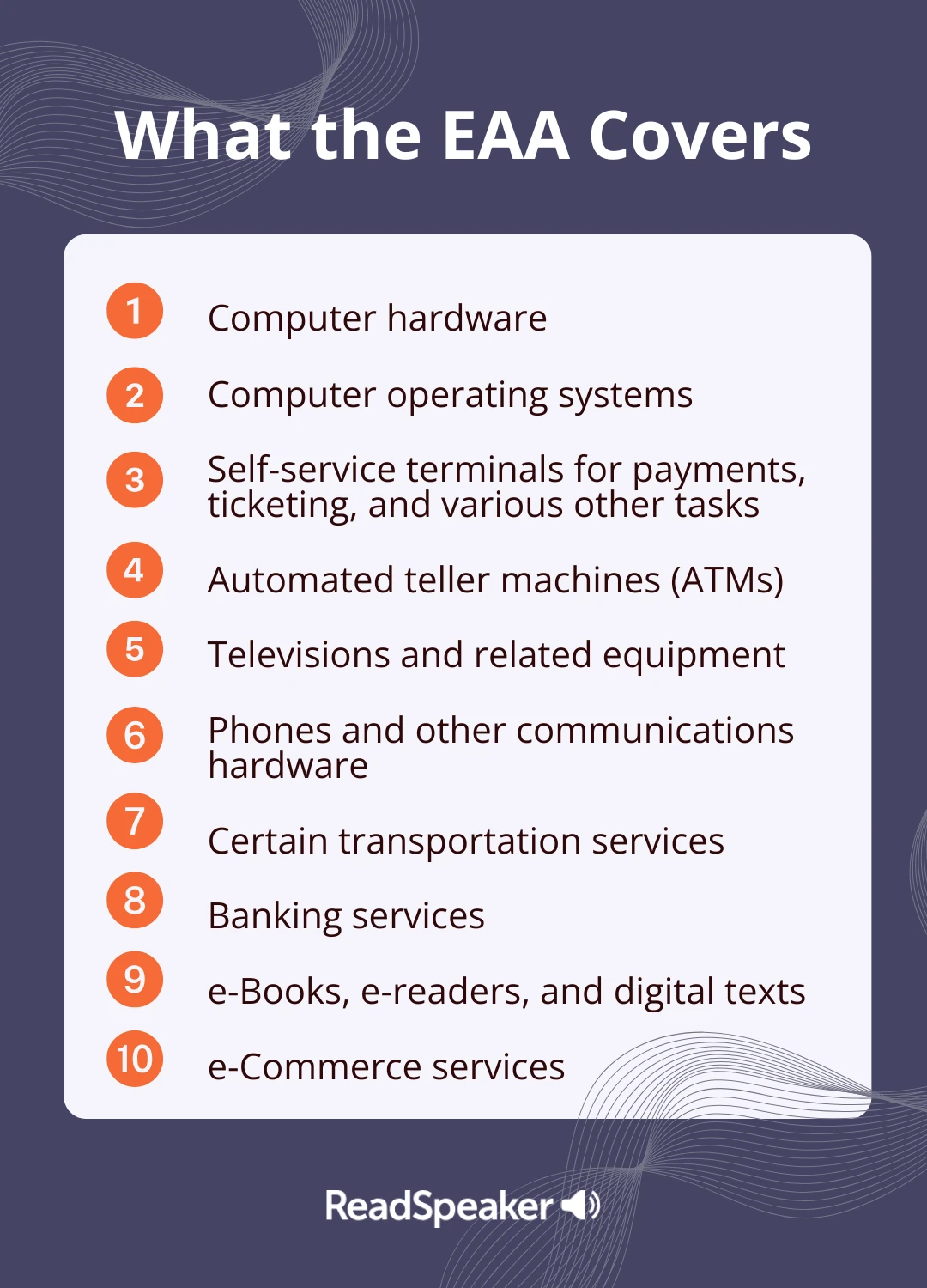
The EAA applies to “products” and “services.” Particular products and services listed in the EAA include:
You’ll notice that “e-learning” isn’t explicitly on that list. But that doesn’t mean educators involved in distance learning won’t be affected by EAA requirements.
It’s important to note that when the EAA refers to e-books, it’s not just talking about a file format you read on a tablet. Digital texts or “electronic texts” within an e-learning environment can easily fall under the Act’s definition of e-books, since any kind of digital content used by consumers, like course modules or online textbooks, may be interpreted as e-book material. As a result, the EAA’s rules about offering alternative formats, providing synchronised audio and text, and making sure navigation is accessible apply just as much to online course materials as to a traditional e-book.
Short answer: Yes.
We’ve established that providers of e-learning platforms, including learning management systems (LMS), digital assessment software, and online teaching tools, must ensure their products conform to EAA specifications.
But the educators who use these tools also have a responsibility under the EAA. According to Article 13 of the Act (opens in a new tab):
Service providers shall ensure that they design and provide services in accordance with the accessibility requirements of this Directive.
The Act defines a “service provider” simply as an EU citizen who provides a service. Odds are that includes educators, especially if you charge for your lessons.
Besides, the EAA specifically addresses “e-commerce services,” which it defines as “a service provided at a distance, through websites and mobile device-based services, by electronic means and at the individual request of a consumer…”
That certainly sounds like the online classes we’ve taken. Additionally, here are just a few more scenarios that may apply to your e-learning operation:
As you can see, everyone in the e-learning sector is likely to have some responsibility under the EAA, whether you provide an LMS, offer online courses, or proctor digital exams. So what exactly are these responsibilities? In other words:
The EAA provides accessibility rules in both general and specific formulations. First off, providers of e-learning platforms, content, and services should be aware of the general approach advocated by the EAA: the POUR principles and universal design.
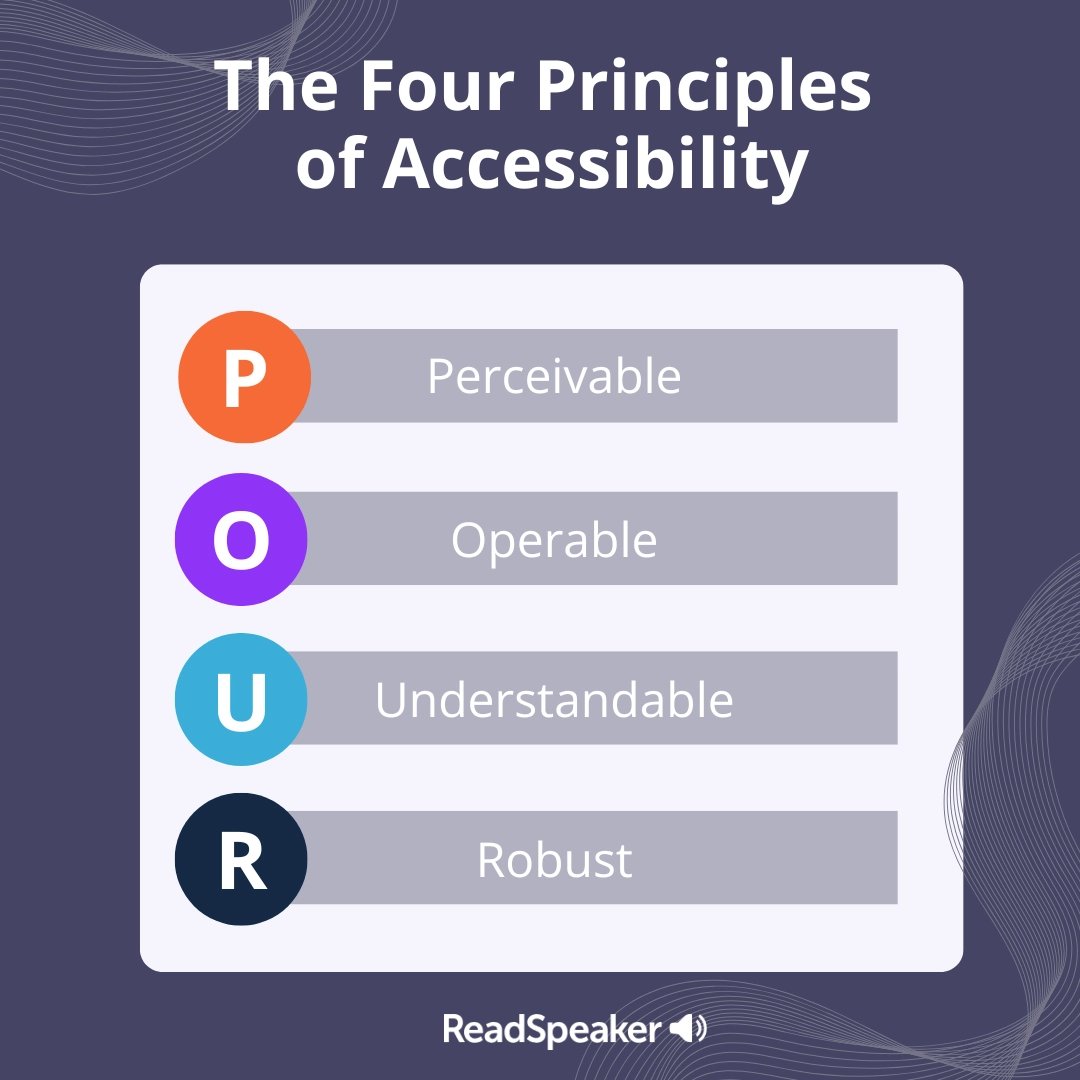
Line 47 of the EAA’s introduction (opens in a new tab) refers back to the related EU Web Accessibility Directive, which requires all websites and mobile apps to be:
Together, these principles form the acronym “POUR.” If that sounds familiar, that’s because it’s the organizing principle behind the Web Content Accessibility Guidelines (opens in a new tab) (WCAG). While the EAA doesn’t explicitly require conformance to WCAG 2.2 (or any previous versions of the guidelines), strong WCAG performance is likely to also comply with the EAA.
Confused about how WCAG applies to your digital systems? Learn what you need to know in our simple WCAG Web Accessibility Guide.
The other general requirement listed in the EAA may also be familiar to e-learning professionals: Universal design. Line 50 of the EAA preamble (opens in a new tab) states that:
Accessibility should be achieved by the systematic removal and prevention of barriers, preferably through a universal design or “design for all” approach, which contributes to ensuring access for persons with disabilities on an equal basis with others.
The EAA defines “universal design” by referring back to the United Nations Convention on the Rights of Persons With Disabilities (opens in a new tab) (CRPD).
According to the CRPD, universal design “means the design of products, environments, programmes and services to be usable by all people, to the greatest extent possible, without the need for adaptation or specialized design.”
Luckily, the education non-profit CAST has done a lot of work adapting universal design methodologies into a comprehensive framework for education: Universal Design for Learning (opens in a new tab) (UDL).
Learn more about UDL, and its role in e-learning environments, in our comprehensive introduction to Universal Design for Learning.
So how does the EAA say e-learning practitioners should apply POUR principles and UDL? The Act does provide a few specifics.
Annex I of the EAA includes a long list of “accessibility requirements for products and services,” including electronic texts. As applied to the e-learning field, these requirements include (but are not limited to):
Note that when the EAA refers to e-books, it’s not just talking about a file format you read on an e-reader. Digital texts or “electronic texts” within an e-learning environment can easily fall under the Act’s definition of e-books, since any kind of digital content used by consumers, like course modules or online textbooks, may be interpreted as e-book material.
As a result, the EAA’s rules about offering alternative formats, providing synchronized audio and text, and making sure navigation is accessible apply just as much to online course materials as to a traditional e-book.
At any rate, these are just a few accessibility features that educators should make available within their e-learning platforms. But the EAA’s Annex I also lists some important “functional performance criteria.” These are written to ensure that products and services are accessible for people with specific disabilities.
According to the EAA, products and services, and therefore e-learning environments, must be designed for people with:
The EAA requires products and services to provide “at least one mode of operation” that does not require a particular sense to operate. For example, your online lessons can’t rely on vision or hearing or perception of color alone; learning content must appear in multiple media.
Text-to-speech tools from ReadSpeaker achieve this goal, helping e-learning providers comply with the EAA requirements. ReadSpeaker’s TTS tools integrate seamlessly into your LMS, assessment platform, or other digital learning environment.
ReadSpeaker provides natural, lifelike AI voices that audio-enable any and all text, plus a suite of reading and writing tools, including text resizing and font adjustments.
To find out more about the EAA, who it affects and the implications of it, our roundtable with experts from European Commission, European EdTech Alliance, EdTech Italia, European Joint Technical Board on eAccessibility, University of Salamanca is now available to watch on-demand (opens in a new tab).
Need to move toward EAA compliance quickly? ReadSpeaker TTS can be an important part of your strategy. Contact us today.
Education
How Moodle Marketplace and Certified Integrations make it easier for institutions to find trusted solutions and build more inclusive learning experiences.
Education
See how ILIAS and ReadSpeaker's text-to-speech technology work together to create more flexible learning experiences, with insights from the University of Stuttgart.
Education
Over the past year, we’ve immersed ourselves in the digital assessment community, through conferences, webinars, research, podcasts, and conversations with assessment leaders. Along the way, several themes have consistently emerged. These are the ideas we believe are shaping the future of accessible digital assessment.