


Education
Integrity Meets Inclusion: Building Reliable Online Assessments in the Age of AI
Discover how ReadSpeaker and SMOWL combine academic integrity and accessibility to support reliable, inclusive online assessments within the Moodle ecosystem.
April 6, 2021
Thankfully, there are a growing number of accommodations in today’s learning landscape. With continued focus on accessibility, assessment accommodations are key to giving all learners… Read the full article
Thankfully, there are a growing number of accommodations in today’s learning landscape. With continued focus on accessibility, assessment accommodations are key to giving all learners an equal opportunity to exhibit the knowledge and skills they have acquired.
Assessment accommodations involve changes in how an assessment is presented, or how the individual is required to respond. They are meant to provide equal access to the examination for any applicant, even those with disabilities or learning difficulties. Accommodations are intended to lessen the impact of the learner’s functional limitation without:
For early education, accommodations are individually determined for a given student by his or her IEP team. And while accommodations are of course important for reading assessments, they are important for all subjects so participants can be tested fairly in all subjects.
Accommodations in testing are used so that a student with a disability can more fully show what they know or can do. Assessment accommodations, much as those in the classroom, fall into 4 main categories:
As education technology advances, text to speech is a key tool to assist in delivering accommodations, including those for assessments. Text to speech helps institutions provide presentation and response accommodations by reading text and answers out loud. At the same time it reduces undue hardship on organisations to provide accommodations by replacing human resources with technology.
Text to speech supports both the individual test taker, the teacher giving the assessment and the organisation that is required to provide accommodations.
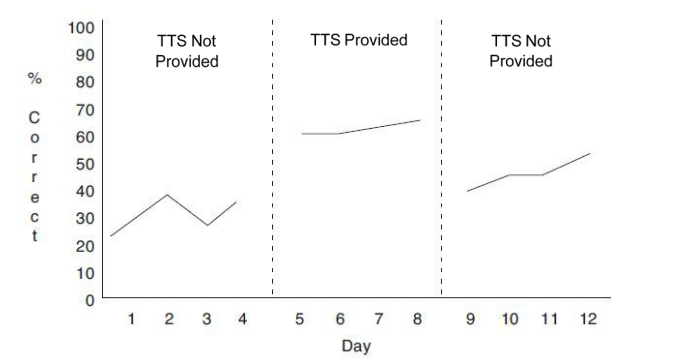
And it succeeds. Results for assessments taken with text to speech accommodations are systematically better than those without.
In the past, students with documented disabilities, English learners (ELS), and English learners with disabilities were allowed accommodations. As more learning institutions are embracing Universal Design for Learning, these concepts are now being rolled out for all students, and content, including assessments (opens in a new tab). This increases the access to assessments for all students, not just those with registered IEP plans, disabilities, or English as a second language learners.
As more institutions use technology-based assessments, many assessments offer new ways to provide all students with access to the content.
They may have features such as:
These new approaches to accessible content allow for more accurate measurement of all students’ knowledge and skills and are an increasingly important part of technology-based testing.
Due to the COVID pandemic, many schools and universities have been unable to offer in person exams. So it’s never been more important for educators to provide robust, reliable alternatives to traditional assessment practices.
Digital assessments are inherently more flexible at supporting accessibility than traditional methods of testing:
The ethos behind [accessibility within online assessments] is to ensure equal opportunity to education. Online assessment supports those with disabilities. Platform features can be adjusted using a disability adjustment code to better suit students with visual impairments, learning difficulties, mental health issues or language challenges, making the assessment experience as smooth, and as fair, as possible.
By readily combining assistive technology such as text to speech with digital assessment, all learners can be supported with fair adjustments that allow them to access and answer questions independently. Imagine a learning disabled student taking an exam with their peers thanks to a read aloud application, as opposed to having someone read the questions and answers out to them.
Now more than ever before, learning institutions must provide digital learning platforms that students have the best possible learning experience, no matter where they are or what their learning ability is. Incorporating online assessment tools, is an important element for institutions to deliver on this.
An integral part of assessment accommodations requirements is that they must not place ‘undue burden’ on the institution. In todays’ environment, with decreasing budgets and increasing strain on staff, human assessment support can be prohibitively costly. With traditional accommodations support institutions may struggle, and ultimately fail, to provide what their learners need. But in the new era of educational technology advances, digital tools such as text to speech are an effective and cost efficient way to ensure the best assessment accommodations without straining human and financial resources. With advancing developments text to speech has become both easy to integrate, intuitive to use and cost efficient to put in place, making effective accommodations within reach of most institutions.
Accommodations for assessments are not only appropriate for schooling institutions, but can and should be provided across all areas of education, including adult education and corporate learning. While text to speech assists employees in learning material, providing accommodations will enable applicants to better demonstrate their mastery of job-related competencies or knowledge, skills, and abilities (KSAs) and complete required training successfully.
Assessments are a critical element of the teaching and learning process. Using technology is the next logical step to replace outdated, cumbersome, paper-based assessment processes. Education technology companies and digital learning platforms such as Learnosity (link to Learnisity page) are supporting educational institutions by helping make digital assessments standard practice in today’s increasingly blended education environment. Learning management systems are even able to integrate text to speech plug-ins such as ReadSpeaker for Brightspace D2L (opens in a new tab). This provides assessment and assignment solutions directly in the Learning Management System interface (opens in a new tab), making the process intuitive and easy to use for both students and educators (opens in a new tab).
The most successful and innovative organisations will be embracing digital assessment accommodations.
Find out how ReadSpeaker can help your institution with assessment accommodations:
Education
Discover how ReadSpeaker and SMOWL combine academic integrity and accessibility to support reliable, inclusive online assessments within the Moodle ecosystem.
Education
How Moodle Marketplace and Certified Integrations make it easier for institutions to find trusted solutions and build more inclusive learning experiences.
Education
See how ILIAS and ReadSpeaker's text-to-speech technology work together to create more flexible learning experiences, with insights from the University of Stuttgart.