Education
Building Trusted Learning Ecosystems in Moodle That Are Ready for What's Next
How Moodle Marketplace and Certified Integrations make it easier for institutions to find trusted solutions and build more inclusive learning experiences.
November 25, 2025
Key insights on how text-to-speech supports accessibility and inclusivity in education, boosting learner confidence and equity in classrooms.
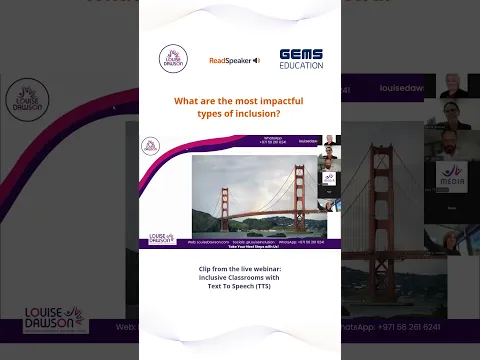
Inclusion expert Louise Dawson (opens in a new tab) recently hosted a powerful discussion on how technology, and text-to-speech in particular, can transform accessibility and inclusion in learning.
Joined by Berna Bouwer, Corporate Head of Inclusion at GEMS Head Office, and Jason Giddens from ReadSpeaker, the session explored what happens when accessibility moves beyond compliance and becomes a lived experience for every learner.
At its heart, the webinar was about something really simple: giving everyone access to written content through listening, and, in doing so, helping every learner feel seen, heard, and capable.
Let’s go through some of the best insights from the webinar to help us take the first steps towards accessible and inclusive education.
What are the most impactful types of inclusion? What are the most impactful transformative tools? According to Berna Bouwer, the most impactful kind of inclusion is not about policies or checklists. It’s about confidence. It is about those tools that are actually embedded in our daily lives that make us feel we belong.
When educators use inclusion as a tool to help students feel they are “good enough”, learning becomes a shared space of trust. Belonging turns inclusion from a mandate into a mindset, one that shapes confidence and identity as much as academic progress.
 (play video)
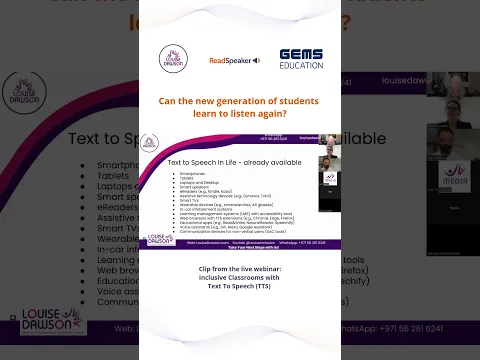
Today’s students grow up surrounded by visual input, short videos, fast scrolls, constant stimuli. Listening, real listening, often gets lost.
Integrating text-to-speech into everyday learning can quietly rebuild that skill. By pairing visual and auditory learning, students learn to process information more deeply, sometimes without even realising they’re doing it.
 (play video)
When we talk about text-to-speech, we’re not just talking about accessibility. We’re talking about voice, the ability for every learner to express ideas, to be heard, to meet high expectations.
To conclude her speech, Berna Bouwer made it clear that TTS doesn’t lower the bar; it helps raise it. With the right tools in place, students can aim higher and achieve the outcomes we know they’re capable of reaching.
 (play video)
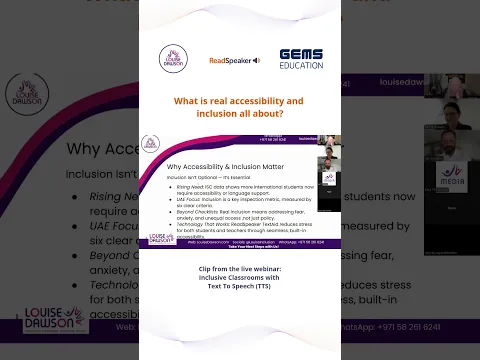
As Jason Giddens rightly points out, true inclusion goes deeper than compliance. It’s about the child who dreads reading aloud, the student learning in a second language, and the teacher balancing twenty different needs.
When accessibility is built in, not bolted on, it lightens the load for everyone, reducing stress for students and teachers alike. This is where thoughtful technology can make inclusion practical, sustainable, and human.
 (play video)
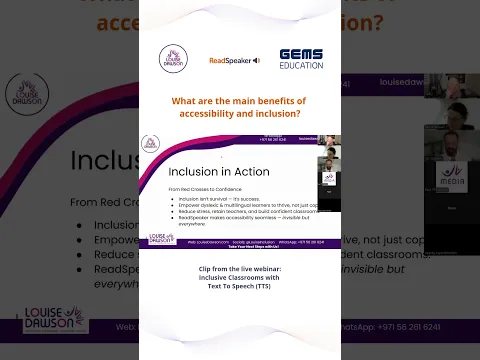
In the end, inclusion works best when it’s invisible, woven naturally into every learning experience.
That’s the role ReadSpeaker plays: creating calm, confidence, and equality in classrooms where every learner, regardless of ability, language, or background, has the same opportunity to succeed.
Because when inclusion is done right, everyone benefits.
 (play video)
Creating truly inclusive learning environments isn’t about adding more tools: it’s about removing barriers. The webinar speakers made it clear that when accessibility is woven into everyday practice, learners don’t experience it as support; they experience it as confidence, independence, and belonging. That’s the real impact of giving students a consistent way to access content in the format that works for them.
And while technology plays a role, the real shift comes from educators and institutions choosing to make inclusion part of the learning culture. When listening becomes as natural as reading, and when all students feel their needs are anticipated, not accommodated, we move closer to classrooms where every learner has the space to thrive.
Looking to improve digital inclusivity at your educational institution?
Contact usIf you don’t want to miss webinars like this one, follow us on social media to stay up to date with all our events!
Education
How Moodle Marketplace and Certified Integrations make it easier for institutions to find trusted solutions and build more inclusive learning experiences.
Education
See how ILIAS and ReadSpeaker's text-to-speech technology work together to create more flexible learning experiences, with insights from the University of Stuttgart.
Education
Over the past year, we’ve immersed ourselves in the digital assessment community, through conferences, webinars, research, podcasts, and conversations with assessment leaders. Along the way, several themes have consistently emerged. These are the ideas we believe are shaping the future of accessible digital assessment.