Education
Building Trusted Learning Ecosystems in Moodle That Are Ready for What's Next
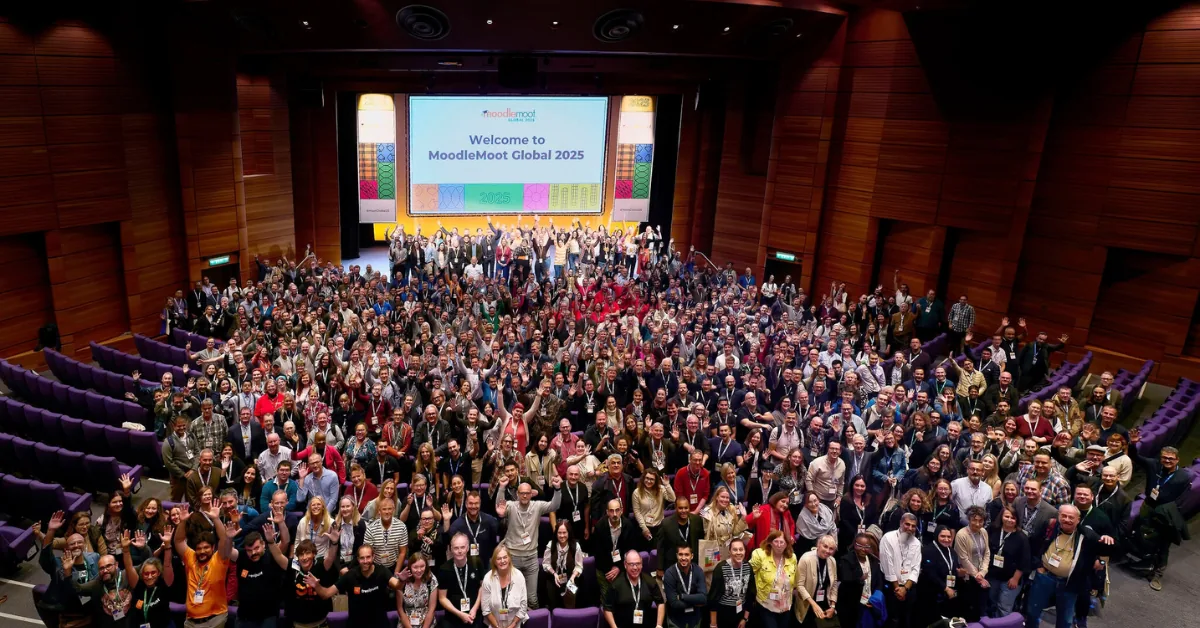
How Moodle Marketplace and Certified Integrations make it easier for institutions to find trusted solutions and build more inclusive learning experiences.
May 4, 2026
In an interview with our partner aNewSpring, we explore the link between learning accessibility and corporate capability. And we share our Accessibility Checklist to help enhance your approach to effective upskilling.
ReadSpeaker’s partnership with corporate learning platform aNewSpring enables Text to Speech to be integrated quickly and easily into its learning environment, facilitating accessibility. In this piece, we talk to aNewSpring’s Famke Vromans about corporate upskilling, and why learning accessibility is becoming central to developing real workforce capability.
Many organisations still treat accessibility as a compliance exercise. Training content is audited against standards, accommodations are made if and when requested, and the requirement is considered fulfilled.
But that approach misses a fundamental point. Corporate upskilling programs don’t succeed because they meet compliance benchmarks. They succeed when employees engage with content consistently enough to change how they work.
“Corporate learning is moving towards personalised, skills-based experiences at scale. The question is shifting from ‘did someone complete a course?’ to ‘can this person actually do the job?’,” says Famke Vromans, Team Leader Marketing at aNewSpring. “That changes everything about how you design and measure learning. But that only works if the learning actually reaches everyone.”
In this landscape, accessibility becomes something else entirely: not a requirement, but a practical enabler of learning effectiveness.
When Penn Foster introduced Text to Speech (TTS), it saw a 54% increase in 30-day course completion rates. More notably, 25% of learners used TTS during assessments, far beyond those with documented accommodations.
This wasn’t occasional usage, but widespread, voluntary adoption. Accessibility makes this kind of engagement possible at scale. But it does more than that too, as the more people that engage, the more insights businesses can gain around the skills gaps that need to be closed.
“A platform that excludes part of your workforce doesn’t just fail those learners, it gives you an incomplete picture of your organisation’s skills,” says Famke. “And in a world where skills data is your competitive edge, that’s a real problem.”
In our conversation with Famke, we discuss why accessibility in learning enables organisations to understand, and develop, the right workforce skills. And we explore the simple ways to embed TTS technology to achieve maximum impact in learning effectiveness (the full Q&A can be found at the end of this article).
Compliance-led accessibility treats learner differences as exceptions. The model is reactive: identify need, provide accommodation, document the response.
The problem is that upskilling programs operate in environments where variation isn’t the exception, it’s the norm. Employees differ in how they process information, manage time and attention, and balance learning with a whole variety of daily responsibilities.
Designing for an “average learner” and retrofitting accessibility later creates friction at every stage. Content may be technically compliant, but still difficult to engage with in practice.
The result is familiar: high completion rates, low application.
The evidence for the benefits of multimodal learning is well established. People retain and apply information more effectively when they can access content in multiple formats, control the pace of learning, and revisit material in context.
It also changes when learning happens. Employees are no longer limited to sitting in front of a screen. They can engage with content during commutes, between meetings, or while handling routine tasks. Learning becomes continuous rather than scheduled.
These are often framed as accessibility features. In reality, they are conditions for effective learning. And they become particularly powerful when aligned to strategic objectives.
“Learning needs to be clear about what it’s for: what job role it supports, what on-the-job behaviour it’s meant to change, and how it connects to a broader organisational goal or capability need,” says Famke.
When employees can see a direct line between what they’re learning and what they’re expected to do differently, and can then access the content in the way they learn best, organizations start driving the workforce capabilities they need to achieve business outcomes.
 (enlarge image)
 The organizations seeing the strongest outcomes are those that treat accessibility not as an overlay, but as part of the learning infrastructure itself, available to everyone. This is so powerful because it removes a critical barrier in the workplace: disclosure.
Many employees who would benefit from support never formally request it. Recent research of 9,000 job seekers and employees (opens in a new tab) showed that nearly 60% think accommodations are critical to workplace success, yet more than half (56%) do not disclose their requirements to employers, and 77% said they would like to be able to assess what might be available to them using anonymous tools.
When tools like Text to Speech are made universally available, employees can access what they need without identifying themselves or navigating administrative processes. In practical terms, it means built-in flexibility rather than alternative formats on request, tools that are immediately available to everyone without additional steps, and one version of content that works for lots of different learners.
This is also where LMS-level integration becomes critical. Integrating ReadSpeaker’s TTS technology with natural sounding voices within aNewSpring allows learning content to be experienced in multiple ways without changing the content itself.
A single course can be read, listened to at a preferred speed, translated in real time, or followed with synchronised highlighting, depending on what the learner needs in that moment. From an implementation perspective, there is no need to redesign content to make it accessible.
From a learner perspective, there is no need to ask for support. It’s already given.
Positioning Text to Speech as an accessibility feature for all learners also helps address a much broader challenge for employees: lack of time.
“People aren’t short on willingness to learn, they’re short on time and focus,” says Famke. “The answer isn’t just shorter content, it’s smarter delivery. Adaptive learning that adjusts to where someone already is, so they’re not sitting through things they already know. Personalised learning paths that target the actual gap, not a generic curriculum. And automation that removes the admin friction around enrolment and scheduling, so accessing learning is as frictionless as possible.”
Multimodal access, including Text-to-Speech technology, makes it possible to engage in shorter, more flexible moments throughout the day, making learning compatible with the reality of the workday. The effects are measurable: learning can happen at any time, complex topics can be revisited without friction, and cognitive load is reduced.
This approach supports groups that are often underserved by traditional training design, including multilingual employees, visually impaired and neurodiverse learners. But it doesn’t limit the benefits to these groups. They scale across the entire workforce.
This is where many upskilling strategies still fall short. Success is still measured in terms of course completion rates and assessment scores, metrics that reflect content consumption, not capability.
“Completion rates are easy to measure, which is probably why they stuck around for so long. But they don’t tell you much,” says Famke. “The real signal is whether people can actually do something differently after the training.”
That outcome depends on consistent, meaningful engagement, which only happens when learning is accessible to all in practice, not just in principle. Accessible learning design influences a different set of outcomes.
Instead of asking whether employees finished training, organisations can start to measure:
When learners can engage with content in ways that suit them, they engage more deeply. That depth is what translates into consistent application.
One useful signal is voluntary behavior. When employees choose to use tools like Text to Speech, without being required to, it indicates they are actively optimizing how they learn. That’s a very different dynamic from compliance-driven usage.
Expectations are fast evolving in terms of what learning platforms are expected to deliver. It’s no longer enough to host and distribute content.
“The market is splitting between platforms that just deliver content, and platforms that actually tell you something meaningful about capability. Content is increasingly a commodity. What matters next is skills intelligence,” says Famke. “Knowing which skills exist in your workforce, which are missing, and which will matter in two years. That’s the direction we’re heading.”
This shift places new demands on learning design. To understand capability, organisations need reliable signals: who is engaging, how are they engaging, and is that engagement leading to application?
If accessibility limits who can fully participate, those signals become incomplete. Put simply, accessible learning isn’t just better for learners, it’s essential for understanding workforce capability.
Most organisations already understand the value of accessible learning. It’s knowing where to apply it without disrupting existing programs.
A practical starting point is to look for friction: where do learners drop off, which modules take the longest to complete, and where do support requests cluster?
Beyond that, focus on removing barriers, not adding content. In many cases, enabling multimodal access, particularly through integrated Text to Speech, can unlock immediate improvements across all existing materials.
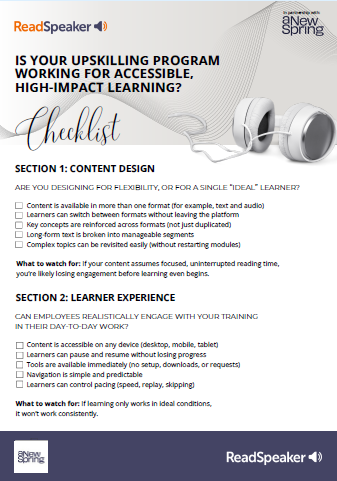
To support this, we’ve developed a simple framework you can use to assess your current approach.
👉 Download the Accessible Upskilling Checklist to identify quick wins across content design, learner experience, and performance measurement.
As aNewSpring further evolves its platform to support upskilling at scale across external audiences, accessibility will continue to be key to delivering consistent, high-quality learning experiences that drive capabilities.
ReadSpeaker helps in this shift, integrating TTS voice technology simply and directly into aNewSpring’s learning environment, without requiring a separate initiative. Accessibility is available from day one, rather than it being layered on top, delivering:
The integration is cloud-based and can be activated without reworking existing content. Administrators retain control, while learners gain immediate flexibility.
In practice, this shifts accessibility to a core part of how learning works.
Accessible learning design doesn’t sit alongside upskilling strategy. It determines whether your upskilling strategy works, or not.
When employees can engage with content on their own terms, across formats, contexts, and schedules, learning moves beyond completion and starts to drive real capability.
Corporate learning is moving towards personalised, skills-based experiences at scale. The question is shifting from “did someone complete a course?” to “can this person actually do the job?” That changes everything about how you design and measure learning. But that only works if the learning actually reaches everyone.
Accessibility is what makes that possible. A platform that excludes part of your workforce doesn’t just fail those learners, it gives you an incomplete picture of your organisation’s skills. And in a world where skills data is your competitive edge, that’s a real problem.
Most LMS platforms were built for internal employee training. The moment you want to deliver training to external audiences at scale, partners, customers, students, they start to crack. You end up with enrolments in spreadsheets, certificates created manually, and no way to actually sell your training. aNewSpring was built specifically for training organisations that need to deliver professional programmes to external audiences without stitching five tools together.
But we’re also moving beyond that. The market is splitting between platforms that just deliver content and platforms that actually tell you something meaningful about capability. Content is increasingly a commodity. What matters next is skills intelligence: knowing which skills exist in your workforce, which are missing, and which will matter in two years. That’s the direction we’re heading.
Honestly, it varies a lot. Most organisations start with accessibility as a compliance requirement, and that’s fine as a starting point. But the more progressive ones are starting to see it differently. When you’re training at scale across diverse audiences, partners, customers, external learners, you can’t afford to design for the average learner. Accessibility stops being a checkbox and starts being a quality standard. The organisations doing it well are the ones that have realised it actually improves outcomes for everyone, not just the learners it was originally intended for.
People aren’t short on willingness to learn, they’re short on time and focus. The answer isn’t just shorter content, it’s smarter delivery. Adaptive learning that adjusts to where someone already is, so they’re not sitting through things they already know. Personalised learning paths that target the actual gap, not a generic curriculum. And automation that removes the admin friction around enrolment and scheduling, so accessing learning is as frictionless as possible.
One thing we’ve built specifically around this is our MemoTrainer. Instead of asking people to block out time for learning, it brings learning to them in short, spaced repetition moments throughout their day. It works with how memory actually functions, reinforcing knowledge at the right intervals so it sticks, without requiring a big time investment. When you reduce the overhead and design around real behaviour, people actually do it.
Completion rates are easy to measure, which is probably why they stuck around for so long. But they don’t tell you much. The real signal is whether people can actually do something differently after the training. That means measuring demonstrated capability, not just time spent. It also means connecting learning data to what’s happening in the rest of the business: performance reviews, recruitment, workforce planning. When you see learning outcomes showing up in those conversations, that’s when you know it’s working.
Start by being honest about what you’re actually measuring today. If the answer is completion rates and satisfaction scores, you’re measuring the wrong things. You don’t need to rebuild everything, but you do need to get clearer on which skills you’re trying to develop and whether your current programmes are actually developing them.
From there, look at where the friction is. Often it’s not the content itself, it’s the operational layer around it: manual enrolments, no self-service, no way to track progress at scale. Fix those first and you create the headroom to focus on what actually matters.
Find out more in our blog published at aNewSpring: Why accessibility is the missing ingredient in effective upskilling programs (opens in a new tab).
Most learning management systems were built for internal training. aNewSpring (opens in a new tab) was built for organizations that teach beyond their own walls.
aNewSpring is an LMS purpose-built for delivering high-quality learning to customers, partners, professionals or entire communities, at scale. It brings authoring, delivery, enrolment, e-commerce and communication together in one platform, so organizations can focus on creating great content rather than managing complexity.
When the technology does its job without getting in the way, training stops being a burden and starts becoming a competitive advantage.
Education
How Moodle Marketplace and Certified Integrations make it easier for institutions to find trusted solutions and build more inclusive learning experiences.
Education
See how ILIAS and ReadSpeaker's text-to-speech technology work together to create more flexible learning experiences, with insights from the University of Stuttgart.
Education
Over the past year, we’ve immersed ourselves in the digital assessment community, through conferences, webinars, research, podcasts, and conversations with assessment leaders. Along the way, several themes have consistently emerged. These are the ideas we believe are shaping the future of accessible digital assessment.